
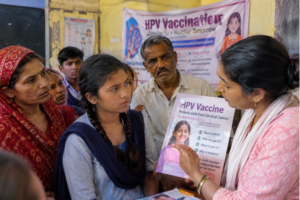
During our school outreach programmes, we noticed something that stayed with us.
When we spoke to parents and teachers about HPV vaccination, many had simple questions:
“What is HPV?”
“Why does my daughter need this vaccine?”
“Is it safe?”
“At what age should it be given?”
Some had never heard of HPV vaccination before.
This made us realise that the challenge is not only about making vaccines available. It is also about making people aware and confident enough to use them.
HPV vaccination is about preventing cancer
HPV, or Human Papillomavirus, is the main cause of cervical cancer. Vaccination can help protect against HPV infection and therefore prevent many future cases of cervical cancer.
Recognising this opportunity, the Government of India launched a nationwide HPV vaccination programme in February 2026, offering free vaccination to eligible 14-year-old girls through government health facilities. The programme aims to reach around 1.2 crore girls every year.
This is a major step forward.
But a vaccine can only protect a child if her family knows about it, understands its importance and chooses to get her vaccinated.
The awareness gap is real
Our conversations in schools showed us that parents often need answers to very basic questions.
They want to know:
- Why is HPV vaccination needed?
- Why is it recommended at this age?
- Is the vaccine safe?
- Where can it be obtained?
- Is it free?
- What happens if the child misses vaccination?
Teachers also have an important role.
In many communities, particularly rural areas, teachers are trusted sources of information for families. If teachers have the right information, they can help parents understand the programme and guide them towards healthcare professionals when they have medical questions.
Awareness must reach the last mile
India has made the vaccine available through the public health system.
Now we need to make sure that information reaches every family.
HPV awareness should become part of school health programmes, parent meetings and community outreach.
The message does not have to be complicated:
Know HPV.
Know the vaccine.
Ask questions.
Make an informed decision.
The Government’s HPV vaccination programme provides an important opportunity to prevent cervical cancer. But reaching the goal will require more than vaccines.
It will require parents who understand, teachers who can guide, healthcare workers who can counsel and communities that trust the information they receive.
Sometimes, prevention starts with a question
During our outreach programmes, we learned that when a parent asks,
“Why does my daughter need this vaccine?”
it is not necessarily refusal.
Sometimes, it is simply a parent asking for help to make the right decision.
And that question deserves an answer.
Because preventing cancer can begin long before cancer develops—with awareness, a conversation and a vaccine.