
The Last Mile of HPV Vaccination Is Not the Vaccine. It Is Trust.
During our school outreach programmes, we began noticing a pattern.
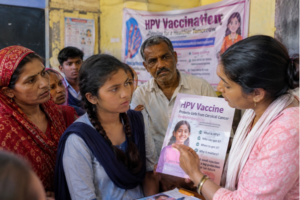
When HPV vaccination came up, parents often asked simple questions:
“What is HPV?”
“Why does my daughter need this vaccine?”
“Is it safe?”
Sometimes, teachers had similar questions.
These conversations made us pause.
India has made the HPV vaccine available through the public health system. But availability does not automatically create acceptance.
The last mile of vaccination is often not a logistics problem.
On 28 February 2026, the Government of India launched a nationwide HPV vaccination programme for approximately 1.2 crore , 14-year-old girls, providing the vaccine free through government health facilities.
This is a significant opportunity for cancer prevention.
But somewhere between the vaccination centre and the child is an important link:
A parent has to understand the need, feel confident about the vaccine and decide to act.
That decision is shaped not only by information, but also by trust.
In our interactions with schools, particularly in rural and underserved communities, the challenge was rarely that parents did not care about their children’s health.
They cared deeply.
The challenge was that HPV was unfamiliar.
Cervical cancer was known to some. HPV was not.
Questions about safety were common. So were questions about the right age for vaccination and where the vaccine could be obtained.
Some conversations were also difficult because HPV is associated with sexual transmission—a subject that can be uncomfortable to discuss with parents of adolescents.
This is where public-health communication matters.
In my recent Hindustan Times article, “Navigating last mile of the HPV vaccination programme,” I argued that the next phase of India’s HPV vaccination effort must focus on the last mile: building parental confidence and engaging communities.
Our experience in schools reinforces this.
A poster saying “Get your daughter vaccinated” is useful.
But a conversation that answers:
Why?
Why now?
Is it safe?
Where do I go?
may be far more powerful.
The difference is simple:
Schools have a unique role in this effort.
For many families, particularly in rural India, a teacher is a trusted source of information. Teachers do not need to provide medical counselling. But they can help start the conversation and connect parents with the health system.
A simple parent-teacher interaction can become an opportunity to explain:
- What HPV is
- Why vaccination matters
- Who is eligible
- Where vaccination is available
- Where parents can get their medical questions answered
The school therefore becomes more than a place where vaccination is facilitated.
We do not need to make HPV communication complicated.
The central message is:
Parents should be able to ask questions without embarrassment and receive answers without judgement.
That is especially important when communicating in rural and underserved communities.
The goal should not be to persuade parents at any cost.
The goal should be to enable informed decisions based on trustworthy information.
India has already taken an important first step by making HPV vaccination available nationally.
The next challenge is ensuring that the vaccine reaches every eligible child who can benefit from it.
That will require more than vaccination centres.
It will require:
Because ultimately, the journey looks like this:
If any link is missing, a child may miss an opportunity for prevention.
Perhaps the most important lesson from our school outreach programmes is this:
When a parent asks,
we should not see a problem.
We should see an opportunity.
An opportunity to listen.
To explain.
To build trust.
And to prevent cancer before it begins.
The vaccine may be the intervention.
But trust is what gets it into the child’s arm.